Music story
Early Rock ’n’ Roll Rhythm Guitar: Listen Beyond the Solo
Four Chuck Berry and Buddy Holly examples reveal the work around a famous guitar phrase: recurring accompaniment, chord accents and the band that keeps a song moving. Listen on the page, one part at a time.

Listen here
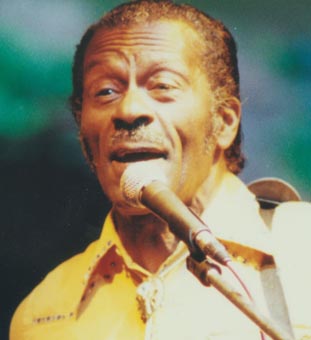
A live Maybellene performance: follow the guitar when the voice enters. The song’s original 1955 release is historical context, not the date of this performance.
Artists in this selection

In this story
The opening guitar lick may get your attention, but early rock ’n’ roll also depends on what happens underneath the singing. A repeating figure, a chord accent and the drummer’s continuing pattern can make a short song feel as if it is always moving. This guide follows those supporting roles through Chuck Berry and Buddy Holly, with four examples you can play on this page.
Start with one question: when the voice takes the foreground, what keeps going? The examples include a live performance of Maybellene and the Crickets’ Peggy Sue appearance on The Ed Sullivan Show. These performances sit alongside historical accounts of the records; the notes identify that distinction where it matters.
Rhythm and lead are jobs within the arrangement
Think of rhythm guitar as a recurring part that helps you follow the beat and the changing chords. Lead guitar brings a melodic gesture forward: an opening phrase, a response to the singer or an instrumental break. One player can move between these jobs. A useful first listen is simply to notice when the guitar supports another part and when it asks for your attention.
Maybellene: listen underneath the voice
The Rock & Roll Hall of Fame’s Berry profile places Maybellene in 1955 and connects it with the country song Ida Red. That history makes a useful starting point: early rock drew energy from several existing musical traditions.
In her analysis of the historical recording, musicologist Kate Lewis describes movement between low notes and chord accompaniment beneath the vocal. Our catalogue example is a live performance. Use it to ask a broader question: how does the guitar change its place when the singing begins, and which other instruments help maintain the motion?
Chuck Berry · 1955
A live Maybellene performance: follow the guitar when the voice enters. The song’s original 1955 release is historical context, not the date of this performance.
Song detailsRoll Over Beethoven: hear the band around the guitar
A guitar-centred listening guide still needs the rest of the band. In his National Recording Registry essay, Berry biographer Bruce Pegg connects the drive of Roll Over Beethoven with Johnnie Johnson’s boogie-woogie piano approach and Berry’s use of that movement on guitar.
Boogie-woogie gives us a helpful idea to follow: a repeating, propulsive accompaniment. As this example plays, move your attention between the recurring support and the phrases that step forward. Ask whether the momentum seems to belong to one instrument or to the exchange between them. Pegg also notes uncertainty in the surviving session documentation, so exact personnel and recording-day claims need care.
Chuck Berry · 1956
Follow the repeating accompaniment and the exchange around the guitar; Pegg’s registry essay provides the historical piano connection.
Song detailsJohnny B. Goode: look beyond the famous entrance
Try a second Berry example with a different listening task. Let the opening phrase pass, then follow the recurring accompaniment while the story unfolds. When an instrumental passage arrives, ask what remains steady underneath it.
Lewis’s analysis describes the historical Johnny B. Goode recording’s repeating blues-shuffle chord movement and continuing rhythm support during the solo. That is a useful way to understand the distinction between spotlight and support: a part can be central to the song’s movement while another part attracts more attention.
Chuck Berry · 1958
After the opening phrase, follow the support beneath the voice and the instrumental passages.
Song detailsPeggy Sue: chords can take the spotlight too
Fender’s account of Buddy Holly’s playing describes the Peggy Sue guitar break as chord-based. A guitar’s foreground moment can therefore depend on rhythm and chord texture as much as a long melodic line. Watch Holly’s hands in the official Ed Sullivan performance available here, then return your attention to the ensemble.
For the studio record’s background, drummer Jerry Allison recalled practising paradiddles—a pattern combining alternating and repeated stick strokes—and Holly asking him to keep the figure going. In his Texas Music interview, Allison also credited Norman Petty with switching echo in and out. His earlier interview with Scott K Fish confirms the paradiddle and his preference for relatively simple parts.
Those are accounts of the recording session. For the television example, use a direct comparison: when the guitar comes forward, what does the percussion continue to do? Follow one part at a time, then put them back together.
Buddy Holly · 1957
Official Ed Sullivan television performance. Compare the guitar’s foreground role with the continuing percussion; studio-session recollections are identified separately in the article.
Song detailsTry a three-pass listen
- First pass: follow the singer and notice where a phrase leaves space.
- Second pass: follow the guitar underneath the voice. Notice repetition, chord accents and changes of role.
- Third pass: follow the drums, bass or piano. Ask what continues when the guitar takes the foreground.
There is no need to name every chord to hear these relationships. Repeat one example and choose a different instrument to follow. Then explore more Chuck Berry, Buddy Holly, rockabilly and the wider 1950s catalogue.
Sources & further reading
6 references
- Rhythm Changes: Rhythm Guitar from Jazz to Funk
Checked November 17, 2026
- ‘Roll Over Beethoven’—Chuck Berry (1956)
Checked November 17, 2026
- Not Fade Away: The Legend and Legacy of Buddy Holly
Checked November 17, 2026
- Q & A: The Crickets
Checked November 17, 2026
- Jerry Allison: Keep Everything Relatively Simple
Checked November 17, 2026
- Chuck Berry
Checked November 17, 2026
Comments (0)
What do you hear? Share a musical detail, a memory or a question. Keep it thoughtful and on topic.
Loading comments…