Music story
How a Small Blues Band Makes a Big Sound
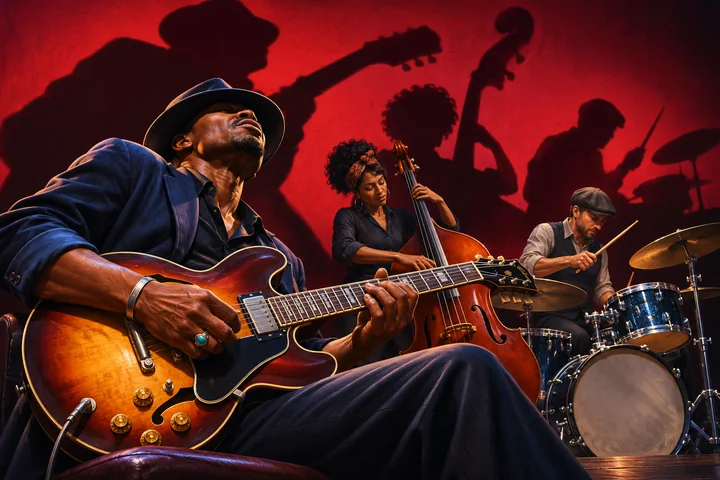
Follow guitar, bass and drums through Cream and Stevie Ray Vaughan: three examples show shared figures, independent movement and space around a solo.
Listen here
Follow the recurring low figure, guitar and drums separately; Cream Topic studio-album audio.
Artists in this selection

In this story
A prominent guitarist can make it easy to overlook the other musicians. Yet a small blues band depends on the relationship between parts: somebody maintains a reference, somebody changes the pressure and somebody leaves room for the next phrase. Big sound does not have to mean a large ensemble. These Cream and Stevie Ray Vaughan examples invite you to hear the band around the guitar.
A recurring figure gives the band a shared reference
Start with Sunshine of Your Love. In John McDermott’s original interviews with Cream and engineer Tom Dowd, Jack Bruce recalls developing the riff on double bass. A riff is a recurring musical idea; it can organize the listener’s attention across several instruments rather than belong only to the loudest one.
Follow the low part first, then the guitar. Notice the points at which the figures seem closely aligned and the points at which another part directs your attention elsewhere. A shared pattern can make an ensemble feel concentrated without requiring every musician to play the same thing throughout.
Then listen to the drums. Ask how they relate to that recurring reference, rather than hearing them as a neutral clock behind the song. A small change in where a drummer places an accent can alter your sense of the same returning figure. This is an invitation to compare the parts, not a claim that every instrument on a studio recording was captured live in one take.
Cream · 1967
Follow the recurring low figure, guitar and drums separately; Cream Topic studio-album audio.
Song detailsKeep listening when the guitarist takes the lead
Crossroads changes the balance of attention. During the instrumental passages, follow the bass as its own line instead of treating it as a quieter copy of the guitar. Then turn to the drums and notice how the performance maintains motion while the guitar develops longer phrases.
Bruce describes the interaction among Cream’s three musicians as part of what changed their treatment of blues. That account gives us a reason to listen to the relationship, but it does not make every moment a competition between soloists. Cooperation can include holding a figure steady while somebody else moves away from it.
The selected third-party Crossroads upload is an audio presentation, not a documented view of the recording session. Its title and general band description do not independently establish a particular venue or take. Use this example for the instrumental relationship you can hear, without turning its upload metadata into session history.
Cream · 1968
Follow the bass and drums through the guitar-led passages; third-party audio upload, exact venue/take not independently established here.
Song detailsA live example reveals room around the phrases
Texas Flood uses the performance identified as Live at the El Mocambo on Vaughan’s official video page. The official discography separately lists the 1983 Texas Flood album. The album’s release date does not make this nine-minute live example its studio master.
Allow a few guitar phrases to unfold before changing your focus. Listen for what the backing does while a note is held, and for the spaces between guitar gestures. Does the ensemble continue a pattern, answer an accent or alter the sense of movement? The question draws attention to the duration around a solo note, rather than only to the note’s pitch or tone.
Make a second pass following the low line. A familiar guitar performance can sound newly organized when you hear its foundation as an active part. Then return to the complete ensemble and notice which interactions remain in your attention.
Stevie Ray Vaughan · 1983
Follow the backing around held guitar notes; official Live at the El Mocambo performance, not the 1983 studio master.
Song detailsCompare activity with density
A busy performance and a dense recording are different things. Three musicians can contribute a great deal of independent motion; a studio production can also layer parts played by the same people. Touring lineup alone cannot prove how many layers a released track contains. Keep that distinction in mind when comparing Cream’s studio example with the live Vaughan performance.
For another listen, choose one question for each example: where is the shared figure, what does the bass do during a solo, and what happens around a sustained guitar note? These are small tasks, but together they reveal why the band’s sound depends on relationships. Continue through blues rock, Cream or Stevie Ray Vaughan to try them elsewhere.
Sources & further reading
3 references
- Cream’s story — John McDermott interviews Jack Bruce, Ginger Baker and Tom Dowd
Checked November 19, 2026
- Texas Flood — official Stevie Ray Vaughan discography
Checked November 19, 2026
- Texas Flood from Live at the El Mocambo — official Stevie Ray Vaughan video
Checked November 19, 2026
Comments (0)
What do you hear? Share a musical detail, a memory or a question. Keep it thoughtful and on topic.
Loading comments…