Music story
Why Bass Matters in Post-Punk: Four Listening Examples
Follow bass, drums and the space between parts through Joy Division, the Cure, Talking Heads and New Order. Four recordings, with the musicians’ own accounts and examples to play as you read.
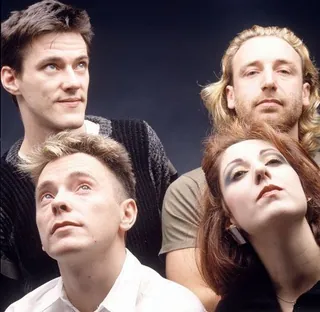
Listen here
Official Joy Division stage-performance video. Follow the bass through a vocal passage, then compare the guitar’s role; recording context and performance context stay separate.
Artists in this selection


In this story
Bass matters in post-punk because it can do more than support the chords: a recurring line can give the listener a tune to follow while other parts change around it. The drums help define the movement, and the spaces between instruments make their separate jobs easier to notice. These are useful listening possibilities, rather than rules that every post-punk record follows.
Try four contrasting examples by Joy Division, the Cure, Talking Heads and New Order. Begin with the band interplay, then follow the route towards a more electronic dance foundation. The final example deliberately opens that boundary; this is a guide to musical relationships, rather than a claim that all four recordings belong to one narrowly defined style.
Start with one repeating idea
Choose one short figure and remember its rhythm before trying to name the notes. Our riff explanation offers a starting point: a returning pattern can introduce a song, accompany the voice or become its most memorable instrumental idea. Now ask which instrument carries that idea. The bass does not have to play the lowest notes at every moment to retain its musical role.
On a second pass, switch to the drums. Notice how their accents sit against the repeated figure, then return to the whole arrangement. You are comparing two jobs: the pattern you recognise and the pulse that gives it a setting. This avoids treating the rhythm section as a single indistinct sound behind the singer.
Transmission: follow the bass as an independent voice
In Dave Haslam’s original interview, Peter Hook recalls playing higher on the bass so that he could hear himself against Bernard Sumner’s loud amplifier. He credits Ian Curtis with recognising how that higher line could work against lower guitar parts. Hook names several Joy Division songs when describing the approach; the recollection explains the band’s division of musical roles, rather than the session history of Transmission.
Rhino’s account of Substance places Transmission among the group’s singles. The official video selected here shows a stage performance. Follow its bass figure through a vocal passage, then try following the guitar instead. Which part supplies continuity, and which catches your attention with an entrance or accent? Compare the two without assuming that the instrument at the front of the mix is doing every important job.
Joy Division · 1979
Official Joy Division stage-performance video. Follow the bass through a vocal passage, then compare the guitar’s role; recording context and performance context stay separate.
Song detailsA Forest: space makes the relationship audible
The Cure’s official release catalogue places A Forest on Seventeen Seconds and credits Robert Smith and Mike Hedges as producers. In Richard Buskin’s interview with Hedges, the producer describes the challenge of making the album’s bass and drums feel tight when the arrangements left so much room. He also recalls an album-wide preference for single-note keyboard lines.
For A Forest itself, Hedges describes a live backing track followed by replacement parts and overdubs. A sparse arrangement can therefore involve substantial production work. In this video, choose one returning line and follow the gap before it comes round again. When another sound becomes more prominent, ask whether the underlying pattern changes or whether your attention changes. Put that beside Transmission: room between the parts can be as useful to follow as an obvious instrumental flourish.
The Cure · 1980
Official Cure video. Choose a returning line and notice the gaps around it; compare changing emphasis with a change in the pattern itself.
Song detailsOnce in a Lifetime: a foundation can stay while the song moves
Talking Heads drummer Chris Frantz gives a practical account of building a song from repeated performance. In his original Quietus interview with Ian Gilchrist, he recalls working out the Once in a Lifetime rhythm with bassist Tina Weymouth, playing it repeatedly, and adding guitar and keyboard parts afterwards. He describes further contrasting parts that allowed the arrangement to change over the foundation.
That account is about musicians maintaining a repeated idea; it does not mean the released recording was simply one sampled fragment. Start this example and hold your attention on the bass-and-drum relationship as the voice and upper parts develop. At a change of section, ask what actually announces the change. Is it a new foundation, a different part above it, or the delivery of the voice? A repeating accompaniment can become the reference against which you notice everything else.
Talking Heads · 1980
Official Talking Heads video. Hold attention on the foundation and ask what announces a change of section above it.
Song detailsBlue Monday: separate the low pulse from the sharp accents
New Order takes the comparison towards electronic dance music. In Rhino’s account of the band’s own retrospective, Gillian Gilbert describes a conscious move towards club listening. Bernard Sumner recalls adding a bass-synth pulse under the bass drum to reinforce its low end, alongside a sharp clap sound. Those are separate elements contributing different kinds of emphasis.
While the existing official lyric video plays, try separating the low thump, the sharper accents and a repeating pitched figure. Notice how many things can contribute to the sense of a beat. Then compare that foundation with the earlier band examples: you can ask the same question about the relationship between parts even when the production tools change. Blue Monday is included as a comparison with electronic dance music, not as a template for every post-punk rhythm section.
New Order · 1983
Official New Order lyric video. Compare the low pulse, sharper accents and repeating pitched figures as a move towards electronic dance music.
Song detailsCompare the four without flattening their differences
- Transmission: follow the bass through the singing, then return to the guitar’s role.
- A Forest: keep one repeated line in mind and notice the room around it.
- Once in a Lifetime: distinguish a stable foundation from changing parts above it.
- Blue Monday: separate low-end weight, pitched repetition and sharper rhythmic accents.
You do not need to identify every instrument correctly on the first attempt. Start with a sound you can recognise, follow its returns, and switch your attention only after you have a clear reference point. The useful comparison is what changes around a repeated idea. A part that seems secondary on the first pass may be the thing that holds the arrangement together.
Continue with our Post-Punk After Hours playlist for a longer sequence, or explore the post-punk catalogue and its neighbouring new-wave recordings. These videos may use different edits from the original recordings discussed in the interviews.
Sources & further reading
6 references
- Peter Hook interview September 2007
Checked November 17, 2026
- Classic Tracks: The Cure 'A Forest'
Checked November 17, 2026
- Seventeen Seconds
Checked November 17, 2026
- All Making Sense: Chris Frantz Interviewed
Checked November 17, 2026
- WATCH: New Order Reveal How BLUE MONDAY was Made
Checked November 17, 2026
- Substance
Checked November 17, 2026
Comments (0)
What do you hear? Share a musical detail, a memory or a question. Keep it thoughtful and on topic.
Loading comments…