Music story
What an Organ Adds to 1960s Rock: Four Listening Examples
Hear how organ changes a band’s arrangement through the Animals, the Spencer Davis Group, the Doors and Procol Harum, with four recordings and the musicians’ own accounts.
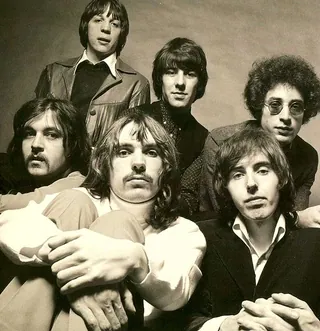
Listen here
Follow Alan Price’s organ around the recurring guitar pattern. Existing Timeless Music upload of the 1964 music video, with AI-enhanced footage; not labelled as a live performance.
Artists in this selection


In this story
An organ can change a rock arrangement without changing its chords. It can connect the spaces between guitar notes, reinforce a repeated figure, open room for an instrumental solo, or supply a melody as memorable as the vocal. These four recordings offer different ways to follow that work.
Start with a practical question: what would become less continuous or less recognisable if you removed the keyboard? Follow one part for a few phrases, then widen your attention to the band. The interesting comparison is how the musicians divide the space. The existing videos below keep their different formats: a restored music video, a promotional film, a remastered album recording and an official lyric video.
The Animals: movement around a repeating guitar
An arpeggio is a chord whose notes arrive separately instead of together. Begin The House of the Rising Sun by following that repeating guitar shape. It gives you a framework to remember while the vocal and organ move around it.
Hilton Valentine described the arrangement as a group effort in his interview with Tom Guerra, including his contribution of the guitar arpeggio and its interaction with Alan Price’s keyboard part. His recollection points towards an arrangement built between musicians; a prominent organ does not make the other parts incidental.
On the first pass, keep the guitar pattern in mind. On the second, follow Price’s organ and notice when it supports the singing and when it becomes more active. Ask whether the movement comes from more notes, longer sounds between other notes, or a change in which part draws your attention. Those are different ways to create momentum over a recurring framework.
The Animals · 1964
Follow Alan Price’s organ around the recurring guitar pattern. Existing Timeless Music upload of the 1964 music video, with AI-enhanced footage; not labelled as a live performance.
Song detailsThe Spencer Davis Group: make the keyboard part of the engine
Move to the concentrated repetition of I’m a Man. Use its recurring instrumental figure as a guide. A riff is a short returning musical idea; listen for the way a pattern can organise a performance alongside the chords and the words.
In Steve Elliott’s interview with Spencer Davis, the interviewer separates Muff Winwood’s bass, Davis’s guitar, Pete York’s drums and Steve Winwood’s vocal and organ. Davis agrees with that account and credits producer Jimmy Miller’s emphasis on the repeated refrain. The exchange is a useful invitation to hear the record as several interacting parts.
Count a steady pulse, then follow the keyboard’s contribution to the forward motion. Notice the small spaces between sung lines: does your attention settle on a new phrase or return to a familiar figure? Next, switch to the bass and drums while keeping the keyboard in the background of your attention. A keyboard can participate in the rhythm as directly as a guitar. The selected video is a 1967 promo, rather than a later Steve Winwood concert.
The Spencer Davis Group · 1967
Follow the keyboard against bass, drums and the recurring vocal refrain. Existing 1967 promo uploaded by Peter Checksfield; not a later concert.
Song detailsThe Doors: open space for an extended instrumental exchange
This selection uses the full Light My Fire album recording in its 2017 remaster, running just over seven minutes. Its extended instrumental section gives the organ and guitar time to develop ideas beyond the vocal passages. Begin by remembering the opening keyboard figure, then notice how your sense of the song changes when the singing gives way to the longer instrumental stretch.
Ray Manzarek identifies the Vox Continental on Light My Fire in his interview with Mike Mettler. In his Fresh Air conversation with Terry Gross, he describes Robby Krieger bringing in the song, the group developing its arrangement and the removal of the long solos for the radio edit. The version matters when an example depends on space for improvisation.
Follow the organ through several phrases, then shift to the guitar while keeping the underlying pulse in mind. Finally, notice the effect of the familiar vocal material returning. Taking time away from a section can change the impact of coming back to it.
Manzarek also describes his live setup: left-hand Fender keyboard bass and right-hand Vox organ. That is separate from this studio recording, whose Rhino/Elektra credits list Larry Knechtel on bass guitar. A band’s stage setup does not establish every part heard on an album.
The Doors · 1967
Follow the organ through the extended instrumental passage and the return to the song. Full 1967 album recording in the 2017 Rhino/Elektra remaster; not the shortened single.
Song detailsProcol Harum: a melodic counterpart to the singer
Before concentrating on the words of A Whiter Shade of Pale, follow Matthew Fisher’s Hammond organ line as a melody with its own identity. A hook is an idea that stays recognisable; it can belong to an instrument as readily as a voice.
In his 1997 Shine On interview, Fisher explains his interest in a featured instrument working in dialogue with a singer. He discusses Bach alongside Booker T. and Jimmy Smith. That account gives the keyboard part a specific purpose: another melodic voice within the song.
In a later BBC Radio 2 interview, Fisher recalls assembling a fixed organ part from favourite improvised fragments while a longer arrangement was being shortened. He distinguishes the Bach references from his own contribution. Presenting the result as an intact Bach melody would miss that process.
Remember the opening organ phrase, then follow what happens when Gary Brooker starts singing. Listen for where the two parts leave room for each other and where the organ catches your attention between vocal phrases. Try recalling the keyboard line afterwards. If it identifies the song without reproducing the vocal melody, the instrument is carrying part of the song’s identity as well as its harmony. This example uses FLY Records’ official lyric video.
Procol Harum · 1967
Remember the organ melody before following the voice. FLY Records’ official lyric video of the 1967 recording; not the later orchestral performance.
Song detailsFour questions for another pass
- The Animals: how does the organ create movement around the repeating guitar?
- The Spencer Davis Group: how does the keyboard contribute to rhythmic momentum?
- The Doors: what becomes possible when the organ has a long instrumental space?
- Procol Harum: how does an organ melody share attention with the singer?
These recordings give the keyboard different jobs. Return to any one of them and follow what changes when you switch your attention between organ, guitar, bass and voice. Continue through the 1960s catalogue, explore psychedelic rock and blues rock, or compare the guitar’s role in our early rock ’n’ roll listening story.
Sources & further reading
6 references
- Tom Guerra interviews Hilton Valentine
Checked November 19, 2026
- Spencer Davis saw big things for Steve Winwood
Checked November 19, 2026
- From the Archives: Doors Keyboardist Ray Manzarek, Continued
Checked November 19, 2026
- R.I.P. — Ray Manzarek of The Doors
Checked November 19, 2026
- Matthew Fisher interviewed for Shine On, August 1997
Checked November 19, 2026
- Matthew Fisher: Reading Music, BBC Radio 2, 25 March 2000
Checked November 19, 2026
Comments (0)
What do you hear? Share a musical detail, a memory or a question. Keep it thoughtful and on topic.
Loading comments…